Why You Keep Buying Things You Don’t Need — And How to Spend More Intentionally EPISODE RE-RELEASE
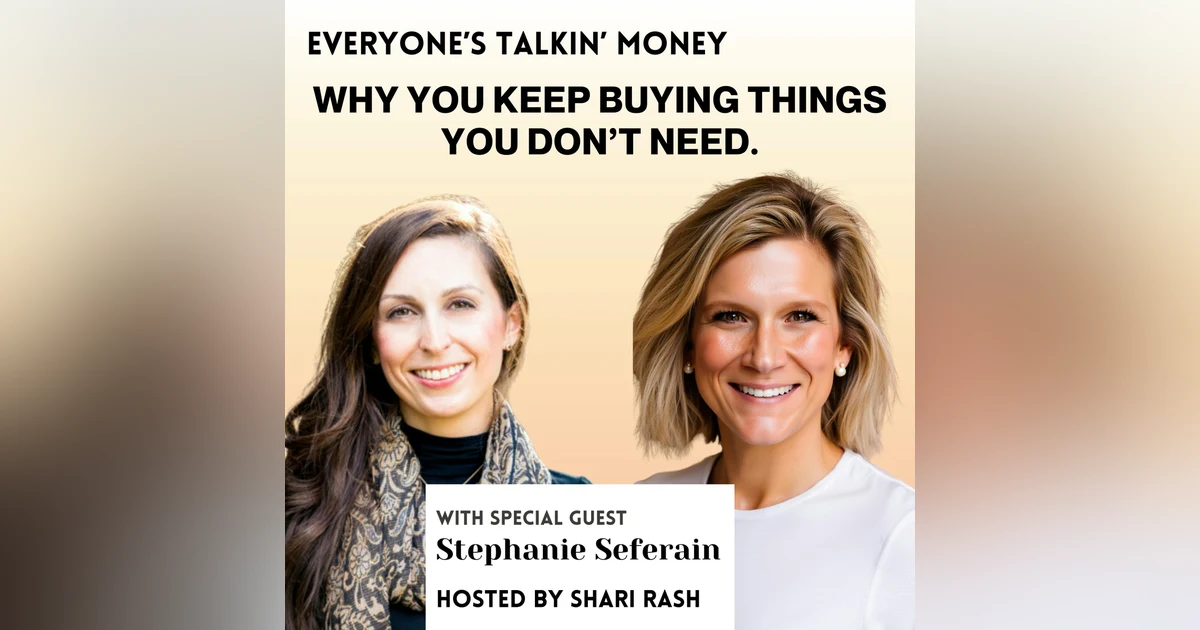
A conversation with Stephanie Seferian of Sustainable Minimalists on clutter, consumption, and the connection between your home and your money


If your home, your calendar, your brain, and your credit card statement all feel a little too full, this conversation is worth revisiting.
In this rereleased episode, Shari Rash sits down with Stephanie Seferian, host of Sustainable Minimalists, to talk about the connection between money, clutter, consumption, and intentional living.
This is not a conversation about never shopping again or getting rid of everything you own. It is about understanding why we buy things we do not really need, how clutter can create stress and decision fatigue, and why spending more intentionally can help you feel more in control of both your home and your money.
For many women, spending does not always look dramatic. It looks like Amazon orders, Target runs, seasonal decor, beauty products, convenience purchases, kids’ stuff, home stuff, and all the little things that quietly pile up — both physically and financially.
Stephanie and Shari talk about how to rethink consumption without shame, how to bring more awareness to what you buy, and why creating a simpler life does not mean creating a smaller life.
You’ll hear:
Why minimalism does not have to mean deprivation
How clutter and overspending can be connected
Why we buy things we do not actually use or need
How to become more intentional before bringing something new into your home
Why “just a few small purchases” can still add up
How to think differently about convenience, consumption, and enough
What it means to build a life with more space, clarity, and purpose
This episode is for anyone who feels like their stuff, spending, and schedule have gotten a little out of hand — and wants a reset that feels practical, not judgmental.
Money is not just about what you earn or save. It is also about what you allow into your life, what you spend on, and whether those choices are supporting the life you actually want.
If you’re ready for personalized, judgment-free financial guidance, learn more about working with Shari. Shari Rash is the founder of GWA Wealth, a virtual advisory firm helping women make confident, values-aligned decisions with their money. Visit GWA Wealth to explore your next step.
Talkin’ Points → where your money gets smarter.
Real talk, practical tips, zero guilt straight to your inbox. Sign up here.
Be sure to like and follow the show on your favorite podcast app!
Keep the conversation going on Instagram @everyonestalkinmoney
Shari Rash is a financial planner and Investment Adviser Representative of GWA Wealth, a Registered Investment Adviser. The information provided in this podcast is for educational and informational purposes only and should not be construed as personalized investment, tax, or legal advice. Listening to this podcast does not create an advisory relationship with Shari Rash or GWA Wealth. All investments involve risk, including the potential loss of principal. Any references to specific investments, strategies, or securities are for illustrative purposes only and are not recommendations. You should consult your own financial advisor, tax professional, or attorney regarding your individual situation before making any financial decisions.
The views expressed by guests are their own and don’t necessarily reflect the views of GWA Wealth.
Learn more about your ad choices. Visit megaphone.fm/adchoices
Lululemon (0:01): Lululemon's airy, fast drying tennis gear keeps you cool when the court gets hot. Breathing out as you breathe in. Wicking away distractions with every reach, every return. Drying as fast as you volley. So even after match point, you'll feel like you wanna do it all again.
Lululemon (0:17): Shop tennis gear in stores and online at lululemon.com.
Google Chrome (0:24): This episode is brought to you by Google Chrome. You think you know a browser, but Gemini in Chrome, That's new. It can help you with practically anything on the web, like restoring a vintage motorcycle from a 50 page restoration block or finally break down that long article you've had open for weeks. Gemini in Chrome is here for it. Ready to make anything online make sense?
Google Chrome (0:42): There's no place like Chrome. Check responses, setup required, compatibility, and availability varies 18 plus.
Choice Hotels (0:48): I wrote a little song to remind you Choice Hotels gets you more of the experiences you value. The Cambria Hotel's got it all. A rooftop bar, have a bowl. Cocktails up here feel just right. It's Cambria amazing.
Unknown Speaker (1:08): Alright. Bring a date, your teen, or
Stephanie Seffran (1:19): Today, I'm bringing back a conversation that feels very relevant right now, especially if you're in a season where your money, your home, your calendar, and your brain all feel a little too full. My guest is Stephanie Seffran, host of Sustainable Minimalists, and this conversation is about so much more than decluttering or buying less. This is a repeat episode. We launched it this time last year, but I loved and you all loved this conversation so much. I just had to bring it back for the summer.
Stephanie Seffran (1:56): When people think about minimalism, I feel like we immediately picture an empty room, one sweater, and someone to tell you to get rid of all of your stuff. And that is not at all what today's episode is. Today's episode is about the relationship between consumption and money. We're gonna talk about why we keep buying things we don't really need, why clutter can become emotional clutter, and why sometimes the answer to feeling more financially in control is not just earn more money or budget better. Sometimes it's pausing long enough to ask, why am I bringing this into my life in the first place?
Stephanie Seffran (2:42): And I think this matters a lot for women who are doing well on paper but still feel like their money disappears because spending does not always look dramatic. Sometimes it looks like convenience purchases, Amazon orders, Target runs, kids stuff, home stuff, beauty stuff, seasonal stuff, and all the little things that quietly pile up in your house and on your credit card statement. The conversation today is not about shame. It's about being more intentional with what you buy, what you keep, what you spend on, and what you allow to take up space in your life. So if you've been feeling like you have too much stuff, too many decisions, too many random expenses, or too many things in your home that you paid for but you don't actually use, this episode is a good reset.
Stephanie Seffran (3:35): So here's my throwback episode with Stephanie Sefferen of Sustainable Minimalists. Stephanie, we just went deep on why your bank account balance should never define your value as a human. While money doesn't equal your worth, it is a tool you can use to live lighter and freer. So let's just crack this open from the minimalist angle. When someone embraces minimalism, what helps them feel more aligned with their values and less tangled up in mindless spending or capitalism's hamster wheel?
Unknown Speaker (4:19): Yeah. Well, I would say the obvious first and foremost, right? Which is when we are on the consumerist hamster wheel of buying, buying, buying, we obviously have to first work, work, work so that we can have the funds to buy all the things. So a minimalist life first and foremost, untangles you from the need to work unnecessarily because, I mean, once our basic needs are met, a lot of the times we're working to support a lifestyle that's been marketed to us, not one that perhaps we want or we're ever looking for.
Stephanie Seffran (5:03): Right. I mean, you you you get the job to pay for the things, and then things become more expensive, and then you need more things, then you need the bigger job, better job, higher paying job to continue paying for all of these things. It really does just keep you on that hamster wheel. It's just are we working to just pay for the things? There's all kinds of things floating around on Instagram, but it's like driving the car with the big payment to the job that takes you away from your home fifty hours a week, and you're doing it for that.
Stephanie Seffran (5:38): Or to pay for the mortgage for the home you're never in because you're working so hard to pay the mortgage. And you can see once you take a step back, it's like, oh, wow. How much of that is true of my life if you look at it from that angle? You've built a whole movement around incremental minimalism. So what does that mean to you and why is slow and steady so important for people who feel buried in stuff?
Unknown Speaker (6:09): Well, I'll start by saying that I consider myself a zero to Oprah type person. Like in general, just in anything in life, I am either black or white. Yes, I'm doing it. And if I'm doing it, I'm all in or no, I'm not doing it at all. Like, that's just my personality, but I have learned through 41 on this planet that zero to Oprah living isn't always the best choice in all situations.
Unknown Speaker (6:38): And that's why I advocate and that's why I advocate for incremental minimalism because I feel as though going from, you know, over consumption, which is what the majority of Americans have been trained to strive for, over not just consumption, but excessive consumption. Going from that to minimalism, getting rid of everything that's non essential, that's a big jump. And so incremental minimalism is about just step one, looking at the things, the items that you've brought into your home that you've acquired and asking yourself, are these items adding to my life? Are they adding to, you know, my and your family's well-being in a tangible, meaningful way? Or could they possibly an incremental minimalism is about asking, could they possibly be detracting from my life and well-being in some way, shape, or form?
Unknown Speaker (7:41): And for me and for a lot of my listeners on my own podcast, the answer is yes. This stuff, the sheer amount of it, and also the striving for it, the working fifty hours a week to get out of the hole of debt that I find myself in because I overbought all the things that were marketed to me. Yes, the stuff is detracting from quality of life, from meaningful moments, from time spent with loved ones, from enjoyment. And if that's the answer that your listeners, as they ask themselves that question come to, I would say step two would be then to start thinking about, the role of stuff in your life and why there's that knee jerk preponderance to keep up with the Joneses and buy the stuff. That would be step two, and step two is way harder than step one.
Stephanie Seffran (8:39): So I can think of a couple ways right now how stuff has a negative influence on my life. One, it's something else to manage. When I walk into every room, I have four children, something's always a mess. There's always something in the room that doesn't belong there. Right?
Stephanie Seffran (8:57): We're pulling stuff from every room because this is the room we decided to play in today. So toys are everywhere. Things are everywhere. But not even just with the kids' stuff, like with stuff around my house, all my extra pillows or whatever it is. It's heavy.
Stephanie Seffran (9:13): And it's just when I'm done working for the day and I walk in, it's like, this is something else I need to do now, right? Because I don't feel relaxed until it's straightened up. It's almost like, well, that's how the less stuff could help me, is to just take some of the load off. So what do you find people say of This is why I'm moving into this movement, why I'm starting the minimalist journey? What are some of the reasons and why is it so heavy?
Stephanie Seffran (9:44): What are the things that are heavy on us?
Unknown Speaker (9:46): Yeah. Well, I guess I'll just share my own story quickly because my story mimics your story, echoes the story I've heard from thousands now, thousands of women. The story's all the same, which is the stuff adds to the mental load and our mental loads, everybody's, but in this case, women's in particular, they're already heavy. We don't need anything else on our mental loads. And so for me, I'll just say, I never really thought about stuff or consumption or even environmental issues, or even how buying stuff related to my finances in any meaningful way.
Unknown Speaker (10:27): I didn't think about any of that until I had my daughter, my first daughter. Once I became a mother, well, for the mothers listening, you know, infants are really a full time job. I did not know how to take care of an infant. I had no free time and the seconds that I could, you know, pick up here or there were spent picking up stuff. My daughter, again, she's like a couple months old.
Unknown Speaker (10:57): She had the best wardrobe. She had a closet lined with like fancy frilly dresses. She had every toy, every enrichment toy, you know, known to man. But again, my family and friends, they were lovely. They bought all the things, so nice of them.
Unknown Speaker (11:15): But my free time was spent in my eight fifty square foot apartment, managing the stuff, finding places to put the stuff, taking care of the stuff, washing the stuff, maintaining the stuff. And I just had a moment where I thought to myself, let's work smarter, not harder. And let's be real with ourselves. My infant daughter does not care about the clothes she's wearing. It's zip up onesies all day long.
Unknown Speaker (11:44): It doesn't matter if it's stained. She does not need these frilly dresses. She does not need these fancy enrichment toys because what would she rather do? She'd rather snuggle. She'd rather be in her swing.
Unknown Speaker (11:57): And that opened up a means of thinking in which I thought, well, if all of this baby stuff is frivolous, does that also mean that some of the stuff that I'm buying for my 30 year old self is also frivolous? And so then I started looking around at my own stuff. Oh, I bought this shirt because it's in style. Not because it looks good on me, not because I necessarily like it, but because it was marketed to me. And after I started having those thoughts for a while, again, this is where the incremental thing comes into play.
Unknown Speaker (12:30): It wasn't the one morning I just woke up and completely changed the way I think about stuff. It was incremental. But later along the line, thought about, well, if this stuff is impacting my mental load, impacting my finances, impacting my free time and my happiness levels, is it also and this is a big part of, you know, my platform. So I'll just mention, like, what is this doing to the planet? What is all this stuff that we're just mindlessly buying because we're told to buy it doing to the resources, the finite resources that our planet has, and where is this stuff going when we're done
Unknown Speaker (13:11): with
Unknown Speaker (13:11): it? So I think that's a really long way of saying the stuff a lot of times is benefiting the manufacturers, the corporations marketing it to us, but it might not be benefiting you and I.
Stephanie Seffran (13:29): That's very powerful, and I feel that, and I can see that because very similar, you know, after a baby shower, a whole room was full of all this stuff, and it's like, how does this one human need all of these things? And there's a reason for all of them, but when your little bit of free time that we have comes to managing the stuff we have, then is it really free time after all? Who's controlling your time? Just like who's controlling your money? Is your money controlling you or are you controlling it?
Stephanie Seffran (14:04): Is your stuff controlling you or are you controlling it? And I think we can apply that kind of train of thought to so many different areas of our life of, are you taking control of it or is it controlling you? And we're a similar age and we established before in your show that the geriatric millennial, which I will not buy into. Will not buy into that at all. So I just keep beating the drum of elder millennial.
Stephanie Seffran (14:32): I don't know if anyone else is, but I'm at least beating that drum. But I almost feel like we were trained to spend money. If you think about all those Remember all those questionnaires we would fill out about ourselves and what are your hobbies? Shopping was always listed as a hobby. Like we were told you go to the mall, you hang out at the mall, you shop.
Stephanie Seffran (14:55): That's what's fun. It was like we buy the, you know, Forever twenty one, the one or two or three time use clothing, and then you throw it away. It was almost like we were trained to become these mass consumers of stuff.
Unknown Speaker (15:12): I'll take that a step further. I a 100% agree with all of it, but I think it's actually more insidious than even that. Marketing is expertly designed to niggle in and find our insecurities, bring them out into the light and amplify them so that then we're trained to buy a thing to fill the insecurity that marketing originally created. And in this era, I mean, you and I did not grow up with targeted ads, algorithms, but in this era in which the algorithm knows more about you and me than perhaps we know about ourselves consciously, it's a scare it's a scary thing. It's a scary time to be a consumer, I would say.
Stephanie Seffran (16:06): Absolutely. Absolutely. And yeah, the algorithm is real. It works. My friends and I all joke if we're talking about something, it's like, just say it loud enough near your phone and it's going to show up in your algorithm at some point.
Stephanie Seffran (16:20): So it's definitely there, and it does. It preys on the insecurities to get you to buy something to fill that void. But instead of getting You're calling out the marketers or you're calling out the algorithm. But then sometimes I think it seems like people get mad at money instead, instead of getting upset with the algorithm. Right?
Stephanie Seffran (16:47): They'll get mad at the money. And why do you think that is? Is it because we don't know? How could the algorithm do this to us? It must be easier to just blame the money.
Unknown Speaker (17:00): So that's a great question. And this is something that, you know, I've been thinking about and need to continue thinking about. Money is the currency, right? Money is not the problem. However, money becomes in so many of our minds, the problem.
Unknown Speaker (17:17): I mean, the only reason that marketing works is because they're taking our money, right? They're taking the currency. And so I'm not sure if I have a great answer for you. I would say that it's easier to malign this nameless faceless thing that can't fight back than it is to fight the institution. Let's say that not only puts the currency, the tool, the money on the pedestal, but also, you know, takes it from us without our even knowing.
Unknown Speaker (17:55): So again, not a great answer, but you're right. The money is just the currency. The money itself fundamentally is not the problem. The money is twisted and turned and, like, I don't know if I'm allowed to swear on your show, but bastardized into the problem in a capitalist society for better or for worse.
Stephanie Seffran (18:17): And so many of us are attached to our things emotionally. You mentioned all of your daughter's clothes when she was a baby and you can then look at it and go, Oh my gosh, that dress, she was so cute when she wore it. Gifts from family members or something that, Well, when I made it, or when I got my first big girl paycheck, I purchased this. How do we start untangling our identity from our possessions? Because I think that's what part of the problem is, is that our identity is tangled in our possession.
Stephanie Seffran (18:50): Then it's harder to get rid of if that's part of us.
Unknown Speaker (18:54): Yes. Well, I think what you're talking about there is the very human tendency to infuse emotion into stuff. Right? It's not just a onesie. It's the onesie I brought my daughter home from the hospital in.
Unknown Speaker (19:12): When you think of it that way, with that emotion attached, it's really hard to get rid of that onesie. I still have that onesie personally. But for me, what really worked was in remembering utility. So every item in our homes has a fundamental purpose for existing. The chair I'm sitting in is meant to be sat on.
Unknown Speaker (19:36): That's why it was created. The candle that I have in my home is used to provide light when the power goes out and maybe a little bit of ambiance. The cup in my cabinet is used to hold water. When I remember utility and I remember that utility is first and foremost, the emotional side, the emotion, the memory, the sentiment, that all gets pushed to the back burner. And so I find for myself, it's really easy to detach from stuff when I remember utility first.
Unknown Speaker (20:19): Okay. This onesie is meant to keep my daughter warm. It's the, the, the love I have for my daughter is not love for the onesie. They're two separate things. My daughter and the onesie are two separate things.
Unknown Speaker (20:35): And so I think it just really comes down to an awareness that, emotions and stuff are different. In certain situations, it's lovely and great to combine them, especially if we have sentimental items like items from deceased loved ones. That's great to a point. It's great to keep your grandmother's vase that she gave you. It's not so great to keep every single thing your grandmother ever unloaded onto you out of a sense, an emotion of guilt or missing.
Unknown Speaker (21:13): And so I think the line is different for every person, but for me, the line is remembering that stuff exists to serve a purpose. My grandmother's china is to serve food. It's not to help me remember my grandmother because I have plenty of pictures and plenty of memories for which to do that.
Stephanie Seffran (21:34): And I think we can say the same thing for money, right? We're attaching our emotions to this stuff and we have to remember what its purpose is. Similarly for money, we attach our emotions to our money, but we have to remember what its purpose is to help us achieve things. I love talking about minimalism in this concept and money because I think there's so many parallels. It's such a similar We can replace minimalism and stuff with money almost interchangeably, and I just find that so fascinating.
Stephanie Seffran (22:09): But just the same way our stuff can drain our mental energy, and if you can talk about that for a minute, what have you noticed between the then incremental shifts and improving our physical environment by removing some of our stuff and mental health?
Unknown Speaker (22:31): Yeah. I'll say for myself. So in my conventional heterosexual marriage, I continue to be the one who is in charge of household maintenance for worse, not for better or for worse, just for worse. We're working on it in our house, but like many homes, traditional gender roles prevail, and I am responsible for the lion's share of the housework. And so the clutter, the excess stuff tends to weigh on me most because I'm responsible for it.
Unknown Speaker (23:13): And so simply being more intentional about not only what we choose to keep, but more importantly, what we choose to allow into our home, has done a great deal to again, reduce that mental load. When there's less stuff, when there's less clothes to wash, when there's less laundry, there's less of a mental load. It's just, you know, simple math at the end of the day. And I'll say to, you know, bringing this back to finances, it's not about, it's not about like buying less stuff or or decluttering stuff so that you can then go to the mall and buy more stuff. Like, that's not what minimalism is for me.
Unknown Speaker (24:02): And I feel like that version of minimalism is peddled again in this capitalist society that wants us to buy at every turn. It's not about decluttering your old stuff or your stuff you don't like anymore and going to get new stuff. It's about addressing the underlying issue that's pushing you to buy stuff that you don't need in the first place. And once I started to like really dig that out, that's where, that's where things started to change for me. That's where the special sauce is.
Unknown Speaker (24:34): Like, that's where, that's where change really lies. So, why do I feel like I need a new couch to, you know, have friends over? Why do I feel like I need to redo my living room before I have a dinner party? And I think that comes back again to keeping up with the Joneses, addressing an insecurity inside of me. While we are taught in a capitalist society to just upgrade, just, you know, put it on the credit card and pay it next month and you know, no harm, no foul.
Unknown Speaker (25:11): When I realized again, a couch is really just meant to be sat on, right? A couch is not meant or supposed to be made to impress friends. But a couch is meant to be sat on and already have a perfectly decent couch for which we can all sit on. That's really the untangling my needs from consumption, really starts to starts to happen at a rapid pace.
Stephanie Seffran (25:39): So you already alluded to this, like minimalism doesn't mean just like decluttering and getting rid of stuff. It's a it's a mindset shift almost, and retraining your brain as to taking control of your surroundings, how your money's spent, where you choose to put your dollars, and talking with your money. What are some of the other myths about minimalism you wish more people understood?
Unknown Speaker (26:05): I like that question. Well, I'll say first and foremost, minimalism is different to different people. It depends on who you talk to, right? If you had Marie Kondo on your show, she would be peddling her online store with tuning forks and this and that and other items that I would consider to be completely frivolous. So minimalism is in the eye of the beholder, let's say.
Unknown Speaker (26:29): For me, a myth that I would love to see, just gone from the face of the earth forever is that minimalism is about deprivation. It's about sacrifice. It's about going without because, you know, minimalists are martyrs or whatever it is. That's not accurate. Minimalism is about quality over quantity.
Unknown Speaker (26:55): It's about curation. It's about, again, if circumstances allow, it's about buying for life as opposed to buying for the trash can. Minimalists like stuff. And in fact, I might even say we like stuff just as much or more than everybody else. We're just conscious and intentional about the stuff we choose to bring into our homes.
Unknown Speaker (27:22): We're not just heading to Amazon because we had a thought that we might need a new X item sometime in the future. Minimalists are not scrolling on Instagram and seeing an ad for, I don't know, name that I'm not into fashion all that much clearly, but minimalists are probably not, you know, seeing a targeted ad on social media, telling them to buy the new fashion item and then just buying it. We're putting in barriers to purchasing to make sure that that item is a built to last B, is gonna work with the other items in our closets that we already own, C, gonna look good on our body, D, aligned with our values. So like we have more steps, but that doesn't mean that we're, you know, sacrificing or martyrs or just living without.
Stephanie Seffran (28:12): What are some of the spending habits people can adopt to stop that cycle of over consumption?
Unknown Speaker (28:20): Oh, well, just practically speaking, number one, put up barriers to buying. In 2025, e commerce, everything's online, credit cards are saved. You know, they have your email address so marketers can insert themselves into your nighttime routine when you're feeling tired, when you're not feeling you know, when you're not making the best decisions. The barriers to buying have been systematically dismantled quietly in ways that you and I may not have even noticed. It's on us to put them back up.
Unknown Speaker (28:59): So unsave your credit card information, delete, or even better unsubscribe from those marketing emails, make social media, your social media time intentional. Don't just scroll and you have a free moment. Like if you must be on it, schedule it, like be intentional about it. I always try to wait twenty four hours before buying anything. So if I have the thought in my head that my daughter needs new shorts for camp, and that's a real life example happening next week, of just going to my favorite site with their two day or even faster shipping, Instead of doing that, I say, I take a breath.
Unknown Speaker (29:43): I take a beat. I say, okay, my daughter needs shorts. Is there a way for me to acquire them on some other, by some other means than Amazon? Can we borrow shorts? Do I have my older daughter's bins of clothes in the attic?
Unknown Speaker (30:01): Can I bring those down and look in there first? Can I, you know, thrift? Can I reach out to my buy nothing group in my neighborhood? I'm willing to bet there's another girl around my daughter's age who has shorts that she just grew out of and is willing to give us shorts. So it's that kind of thing, like make buying the last resort as instead of the knee jerk reaction.
Unknown Speaker (30:26): The knee jerk reaction is what we've been trained to do, but guess what? We're all really smart. We've all got big brains. We can undo that training with a little bit of intention.
Stephanie Seffran (30:37): I love that so much. Instead of buying being the first thing we do, say, I'm to figure this out without having to buy. And you're right. We have an amazing buy nothing Facebook group in my town where everyone's just happy to give their stuff away. We take pictures of thanks so much, here's my kid wearing it, or here's me using it, whatever it is.
Stephanie Seffran (31:02): And it really is a nice community. And it's so true, though. We're just so quick to, all right, let me go run to the store and get it. It's also it kills so many birds with one stone. It helps your pocketbook.
Stephanie Seffran (31:16): It helps the environment. You're feeling more in control of the decisions, your purchasing power. What while we wrap up, what is your favorite example of a small swap or habit that saves both money and the planet? Anytime
Unknown Speaker (31:38): you decide to not buy new, you're making a really great choice for your wallet, your bottom line, and also for the planet, right? Because buying new requires not only a financial premium, you're paying the most for a new item, but the planet is also having to give up resources, water, precious metals, being released in the sense of that item being shipped to you, plastic being manufactured to wrap the item and package the item and send it to your doorstep. So anytime you decide to not buy new, you're doing a great thing for everybody. Now, of course, so many powers that be do not want us to embrace secondhand, want us to not borrow, want us to not thrift, want us to not embrace free secondhand items, right? Because there's no money to be made.
Unknown Speaker (32:36): They can't get our money when we do those actions. And so I encourage everybody who's listening to step away from the stigma, untangle yourselves from the stigma of, oh, new is or second best, secondhand is dirty or secondhand is used or, oh no, that is a mindset that has, that's first of all, incorrect. And second of all, has been propagated Not for our interest. We live in a world of abundance, our country of abundance, at least in which there is way more stuff than there are people who want the stuff. I'm talking clothes.
Unknown Speaker (33:17): I'm talking electronics. I'm talking appliances. I'm talking home goods. I'm talking furniture. You name the category.
Unknown Speaker (33:23): There's plenty of it already in existence. We do not need to make more. We do not need to spend our money on more. And so when you ask about a habit that satisfies the wallet and, you know, helps the planet and is minimalist, I would say just take a few minutes. If you have that, you know, again, knee jerk unconscious, resistance towards secondhand stuff, like take a minute and untangle that.
Unknown Speaker (33:57): And I'll say too here, Sherry, you know, I grew up in the eighties. My family was not well off by any means. I grew up in a single mother household and yet we never ever accepted secondhand. We never thrifted. We always had new, even if the new stuff was like cheap Walmart junk, essentially it was always new because even forty years ago, the, the myth that secondhand is bad or dirty or for a different type of person, I don't even know what the myth is, but even then it was propagated.
Unknown Speaker (34:39): And so to go back to what you said earlier in our conversation about how we've been trained to buy, I would update that to say we've been trained to buy new. New is best. And so I would encourage all of us to think, well, again, who is that benefiting? Is it benefiting us? Like if I could get the blender that I need from my neighbor who doesn't ever use their blender for $0 that's definitely benefiting me.
Unknown Speaker (35:07): It's definitely benefiting the planet. It's not necessarily benefiting Verilux or whatever the brand is of blenders, but new is not best for you and me.
Stephanie Seffran (35:21): And we started our conversation on your show when I mentioned in my limited free time, I like Grand Millennial, and you're like, Well, what is that? And it's pretty much if you take things from your grandma's house. But also, I like it because the furniture is nicer. The antiques, it's made better. So even if we think new is better, it actually isn't.
Stephanie Seffran (35:48): It's not as good quality. It's not going to last as long. It's not even made with real wood. It's like particle board, right? If we're talking furniture, we have to buy a table.
Stephanie Seffran (35:58): We have to put together ourselves. It's not even better stuff. And you're right. Generational parents would never buy anything used or secondhand or like the idea of Facebook Marketplace. It's like, Oh, really?
Stephanie Seffran (36:15): I'm not buying someone else's stuff. And it's like, it could be never have been used. It could have been sitting in a house, never touched on, never sat in, never but that's so interesting. I wonder where that came from. Secondhand isn't good enough, but it's like if you just look at the quality of it, something used versus something new, quality is going to be so much better if you purchase it.
Stephanie Seffran (36:39): It was made twenty five years, thirty years ago.
Unknown Speaker (36:43): That also is intentional. Like the rise of fast fashion and fast furniture, again, that's designed to satisfy a lower price point. Like who can say no to a dining room table that's $300 but it's made to break. It's literally designed to break so that in two years you buy another table for another $300 and look in four years they got $600 out of you. Like it's all very intentional and sure your grandmother's dining room set, it may be dark mahogany wood and it may have, you know, very ornate legs that are out of style, but guess what?
Unknown Speaker (37:30): You can strip that table. You can paint it a lighter, more in fashion color, and then you have a mahogany table that's going to last beyond your lifetime and maybe into your children's lifetimes. And that right there is a conscious consumption personified.
Unknown Speaker (37:51): What
Stephanie Seffran (37:55): a powerful conversation with Stephanie. I love how she reframes minimalism not as deprivation, but as conscious curation. That shift from I can't have that to I'm choosing what serves me best is everything. A few key takeaways I'm walking away with. First, that we've been systematically trained to buy new when second hand is often higher quality and always better for our wallets and the planet.
Stephanie Seffran (38:26): Second, that putting barriers back up to purchasing, like waiting twenty four hours or exploring non buying options first, can completely change our relationship with consumption. But maybe most importantly, Stephanie's reminder that our stuff should serve us, not the other way around. When we're spending our precious free time managing possessions instead of enjoying life, something's got to shift. If this conversation had some light bulbs going off for you, check out Stephanie's podcast, Sustainable Minimalist, and start with just one small change. Maybe it's unsubscribing from those marketing emails or checking your local buy nothing group before making your next purchase.
Stephanie Seffran (39:14): Remember, this is about taking control of your money and your stuff rather than letting your money and your stuff control you. Small incremental changes really do add up to transformations. Thanks for listening, and I'll see you next time on Everyone's Talking Money. If you love what you heard, be sure to rate us on your favorite podcast app and follow us on Instagram at everyone's talking money.
Unknown Speaker (39:58): This episode is brought to you by Google Health. Stop chasing someone else's definition of health. What matters is what's healthy for you. Google Health offers a new kind of coach built with Gemini for effortless tracking, sleep insights, and holistic coaching tailored to you. Visit googlestore.com to learn more and start a new relationship with your health.
Unknown Speaker (40:17): Requires Google account, Google Health app, Internet, and Google Health premium subscription. Features subject to change. Availability and results vary. Not intended for medical purposes. Works independently of Gemini apps.
Unknown Speaker (40:26): Check responses for accuracy.